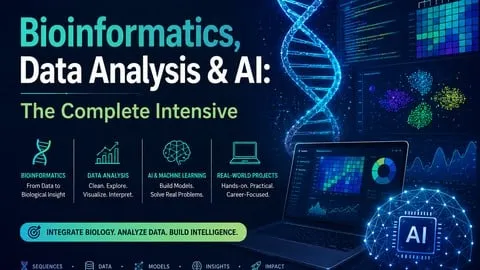
Bioinformatics, Data Analysis & AI
Affiliate link — we may earn a commission. Learn more
Bioinformatics, Data Analysis & AI – Fiada Mothapo
The Bioinformatics, Data Analysis & AI course, taught by Fiada Mothapo, delivers a free, Udemy‑hosted masterclass for anyone wanting to master computational biology in 2026. Updated July 2026, the curriculum blends Python programming, statistical analysis, and modern AI techniques to prepare learners for real‑world genomics projects and industry certifications. By completing the course, students gain hands‑on experience with sequence alignment, variant calling, and machine‑learning pipelines, plus a portfolio‑ready capstone that showcases practical bioinformatics expertise.
What You'll Learn
- Build end‑to‑end bioinformatics pipelines using BLAST, BWA, and samtools on authentic genomic datasets.
- Master Python data‑wrangling with pandas to clean, transform, and visualize clinical and biological data.
- Learn core statistical methods for hypothesis testing, differential expression, and multi‑omics integration.
- Understand AI‑assisted research workflows, including verification of generative model outputs and avoidance of hallucinated citations.
- Create machine‑learning and deep‑learning models that predict gene expression patterns without overfitting.
- Implement reproducible research practices, from version‑controlled notebooks to automated testing of bioinformatics code.
- Apply RNA‑seq differential expression analysis and variant‑calling techniques to real‑world case studies.
- Analyze multi‑omics datasets using integrated Python libraries, preparing for industry technical assessments and certification exams.
Course Details
- Instructor: Fiada Mothapo
- Rating: 5.0 stars (19 reviews)
- Language: English (en‑US)
- Enrolled students: 19
- Certificate: Yes, upon completion
- Includes: Lifetime access, mobile‑friendly platform, 26 interactive Python coding exercises, 60 practice exam questions across two full‑length tests, capstone project for portfolio development
What This Course Covers
Python Fundamentals & Data Wrangling
- Importing, cleaning, and reshaping biological CSV/TSV files with pandas.
- Writing reproducible Jupyter notebooks for exploratory data analysis.
- Performing statistical summaries and visualizations using matplotlib and seaborn.
- Automating data pipelines with functions and modular script structures.
Exploratory Data Analysis & Statistics
- Conducting hypothesis testing on gene expression datasets.
- Applying multiple‑testing correction methods such as Benjamini‑Hochberg.
- Visualizing high‑dimensional omics data with PCA and t‑SNE plots.
- Interpreting p‑values and confidence intervals in a biological context.
Sequence Alignment & Variant Calling
- Running BLAST searches against reference genomes for similarity detection.
- Aligning short reads with BWA and converting SAM to BAM using samtools.
- Performing variant calling, filtration, and annotation on whole‑genome data.
- Validating pipeline results with benchmark datasets and quality metrics.
Machine Learning & Deep Learning for Genomics
- Preparing feature matrices from DNA sequences and expression profiles.
- Training random forest and support vector machine classifiers for phenotype prediction.
- Building convolutional neural networks that learn sequence motifs directly from raw data.
- Evaluating models with cross‑validation, ROC curves, and precision‑recall analysis.
AI Tools & Generative Models in Bioinformatics
- Integrating large‑language models to generate code snippets for bioinformatics tasks.
- Detecting hallucinated citations and correcting erroneous AI‑generated outputs.
- Using prompt engineering to extract domain‑specific insights from generative AI.
- Establishing ethical guidelines for AI‑assisted scientific research.
Capstone Project & Portfolio Development
- Designing a complete end‑to‑end workflow from raw FASTQ files to final report.
- Documenting methodology, results, and reproducibility in a professional portfolio.
- Presenting findings through interactive visual dashboards and markdown reports.
- Receiving feedback on code quality, statistical rigor, and biological interpretation.
Who Should Take This Course
- Bioinformaticians and computational biologists preparing for industry technical assessments.
- Life‑science researchers who need to master Python‑based data wrangling and RNA‑seq analysis.
- Data scientists and machine‑learning engineers transitioning into genomics or healthcare AI.
- Recent graduates and students seeking a portfolio‑ready capstone project for job applications.
- Professionals aiming to earn a certification in bioinformatics or biomedical data analysis.
Prerequisites
- Basic familiarity with biological concepts such as DNA, RNA, and proteins is helpful but not required.
- No prior programming experience needed; the course starts with essential Python fundamentals.
- Recommended: a willingness to experiment with command‑line tools and open‑source bioinformatics software.
Why Enroll in This Course
This Udemy masterclass offers a free coupon that grants 100 % off for a limited time, making high‑quality bioinformatics training accessible without financial barriers. The curriculum balances theoretical foundations with practical, industry‑relevant projects, ensuring learners acquire job‑ready skills faster than generic tutorials. Because the course is continuously updated, students benefit from the latest AI tools and genomic analysis standards, positioning them ahead of peers who rely on outdated resources.
Course Highlights
- Lifetime access to all video lectures, coding exercises, and practice tests.
- **Self‑paced
Affiliate link — we may earn a commission
Affiliate link — we may earn a commission. Learn more