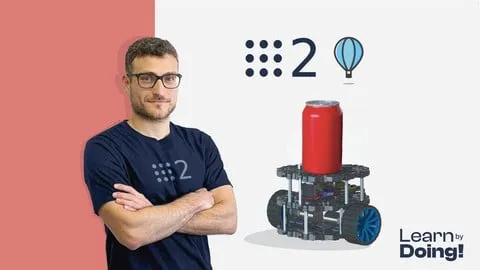
Self Driving and ROS 2 - Learn by Doing! Odometry & Control
Affiliate link — we may earn a commission. Learn more
Master Autonomous Navigation with Self Driving and ROS 2 - Learn by Doing! Odometry & Control
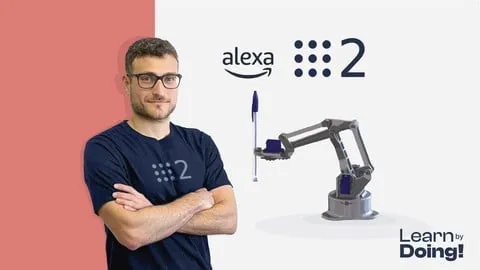
Looking for a comprehensive and free ROS 2 course to jumpstart your career in robotics? The Self Driving and ROS 2 - Learn by Doing! Odometry & Control course, taught by industry expert Antonio Brandi, provides a deep dive into the world of autonomous vehicles and robotics software development. Available on Udemy and updated for 2024, this training allows you to learn ROS 2 online through a practical, project-based approach. By completing this course, students will master the critical skills needed to build a functional self-driving robot, focusing on the essential mathematical and programming foundations of odometry and control systems.
What You'll Learn
- Build a real-world self-driving robot from the ground up using industry-standard tools and frameworks.
- Master ROS 2 (Robot Operating System) to handle communication, node management, and hardware abstraction in complex robotic systems.
- Implement Sensor Fusion algorithms to combine data from multiple sensors for more accurate robot state estimation.
- Create a high-fidelity Digital Twin and simulate your self-driving robot in the Gazebo environment before deploying to physical hardware.
- Program Arduino microcontrollers specifically for robotics applications to bridge the gap between high-level software and low-level actuators.
- Apply Probability Theory and Differential Kinematics to understand how robots move and perceive their environment.
- Utilize the ros2_control library to develop professional-grade controllers for precise robot movement and stability.
- Analyze and implement Kalman Filters and Extended Kalman Filters (EKF) to optimize localization and reduce sensor noise.
Course Details
- Instructor: Antonio Brandi
- Rating: 4.3 stars (over 23,000 reviews)
- Enrolled students: 23,747
- Level: Beginner to Intermediate
- Language: English
- Certificate: Yes, upon completion
- Includes: Lifetime access, mobile-friendly content, and dual-language programming lessons (Python & C++)
What This Course Covers
ROS 2 Foundations and Framework
- Understanding the core architecture of the Robot Operating System 2 (ROS 2)
- Setting up the development environment for autonomous navigation
- Managing nodes, topics, and services for seamless robot communication
- Mastering the TF2 library for coordinate transformations and frame management
Robot Kinematics and Odometry
- Exploring Differential Kinematics for wheeled mobile robots
- Implementing wheel odometry to track robot position and orientation
- Understanding the mathematical relationship between motor speed and robot displacement
- Analyzing error accumulation in dead reckoning and how to mitigate it
Advanced Localization and Sensor Fusion
- Deep dive into Probability Theory as applied to robotics
- Implementing Kalman Filters for optimal state estimation
- Using the Extended Kalman Filter (EKF) for non-linear robot movement
- Combining IMU and encoder data to achieve precise localization
Control Systems and Actuation
- Developing custom controllers to maintain robot trajectory
- Leveraging the ros2_control library for professional hardware interfacing
- Programming Arduino to handle PWM signals and motor driver communication
- Testing control loops in both simulation and real-world scenarios
Simulation and Digital Twin Development
- Creating detailed robot models using URDF (Unified Robot Description Format)
- Building a digital twin to test algorithms without risking physical hardware
- Using the Gazebo simulator to recreate real-world physics and environments
- Validating sensor data and control logic within a virtual space
Who Should Take This Course
- Self-Driving Enthusiasts: Individuals passionate about the future of autonomy who want to understand the "how" behind the technology.
- Makers and Hobbyists: Electronics enthusiasts who want to move beyond simple RC cars to intelligent, autonomous robotic platforms.
- Software Developers: Programmers looking to transition into robotics by learning ROS 2 and the mathematics of motion.
- Engineering Students: Academic learners who need a practical application of control theory, kinematics, and probability.
- ROS 1 Developers: Experienced robotics engineers looking to migrate their skills to the more modern and stable ROS 2 ecosystem.
- Beginner Python and C++ Developers: Coders who want to apply their language skills to a tangible, real-world hardware project.
Prerequisites
- Basic Programming Knowledge: A fundamental understanding of either Python or C++ is recommended, though the course provides dual-language examples to help you learn.
- Mathematics Basics: Familiarity with basic algebra and geometry is helpful for understanding kinematics.
- No Prior Robotics Experience Needed: This course is designed to be beginner-friendly, guiding you from the absolute basics of ROS 2 to advanced control systems.
- Hardware (Optional): While simulation is covered, having an Arduino and basic robot chassis will allow you to follow the "Real Robot" portions of the curriculum.
Why Enroll in This Course
This course stands out because it rejects the "theory-only" approach, instead embracing a "Learn by Doing" philosophy. Every module is structured to take you from a theoretical concept to a simple practical example, and finally to a real-world robot implementation. Because the lessons are developed in both Python and C++, you have the flexibility to learn the language that suits your career goals or become proficient in both.
Currently, there are opportunities to access this high-value training via a free coupon, offering the course at 100% off for a limited time. This makes it an incredible opportunity to gain professional robotics skills without any financial barrier. Whether you are aiming for a career in autonomous vehicles or simply building a home project, the combination of simulation and physical hardware implementation provides a comprehensive learning path that few other tutorials offer.
Course Highlights
- Dual-Language Instruction: All programming tasks are provided in both Python and C++, ensuring maximum accessibility for all developers.
- Three-Step Learning Process: Each section flows from Theory $\rightarrow$ Practical Example $\rightarrow$ Real Robot Application.
- End-to-End Project: You don't just learn isolated skills; you build a complete self-driving robot system from scratch.
- Industry-Standard Tools: Training covers Gazebo, ROS 2, and Arduino, which are the primary tools used in professional robotics labs.
- Comprehensive Certification: Receive a certificate of completion to showcase your expertise in autonomous navigation on your LinkedIn profile or resume.
- Self-Paced Learning: Enjoy lifetime access to the materials, allowing you to revisit complex topics like Kalman Filters at your own speed.
Frequently Asked Questions
Q: Is this course really free? A: Yes, the course is available for free when you use a valid promotional coupon. These coupons are typically offered for a limited time to help students and enthusiasts get started with ROS 2 and robotics.
Q: What will I learn in this self-driving course? A: You will learn the entire pipeline of autonomous navigation, including ROS 2 architecture, robot kinematics, odometry, and control. The course also covers advanced topics like Sensor Fusion using Extended Kalman Filters and the creation of Digital Twins in Gazebo.
Q: Do I get a certificate after completing this course? A: Yes, upon completing all the video lessons and requirements, Udemy provides a certificate of completion. This serves as a great addition to your professional portfolio, proving your competency in ROS 2 and autonomous systems.
Q: Is this course suitable for beginners? A: Absolutely. The course is structured to take you from the basics of the Robot Operating System to advanced control logic. As long as you have a basic grasp of programming (Python or C++), you can follow the curriculum successfully.
Q: How long do I have to enroll for free? A: Free coupons are usually time-sensitive and have a limited number of redemptions. It is highly recommended to enroll as soon as you find an active coupon to ensure you secure lifetime access to the course materials.
Final Thoughts
The Self Driving and ROS 2 - Learn by Doing! Odometry & Control course is an exceptional resource for anyone looking to bridge the gap between theoretical robotics and practical implementation. By focusing on the core pillars of autonomous navigation—odometry, localization, and control—Antonio Brandi provides a roadmap that is both challenging and rewarding. Whether you are a student, a professional engineer, or a hobbyist, this course offers the tools and knowledge necessary to master the complexities of self-driving technology. Start your journey into the world of robotics today and build your first autonomous robot!
Affiliate link — we may earn a commission
Affiliate link — we may earn a commission. Learn more