Mastering Context Design for Intelligent AI Agents
Affiliate link — we may earn a commission. Learn more
Opening Paragraph
Mastering Context Design for Intelligent AI Agents by Vivian Aranha delivers a deep‑dive into prompt engineering, memory management, and tool integration for modern LLM‑driven applications. This Udemy course is the go‑to free [course topic] course for anyone who wants to learn how to build context‑aware AI agents that reason, act, and scale. Updated July 2026, the training covers practical skills such as designing role‑based prompts, orchestrating LangChain pipelines, and creating multi‑turn reasoning workflows. Learners finish with a capstone project that demonstrates real‑world, production‑grade agent design and a certification of completion.
What You'll Learn
- Build context‑rich prompts that combine instructions, examples, and domain knowledge for intelligent AI agents.
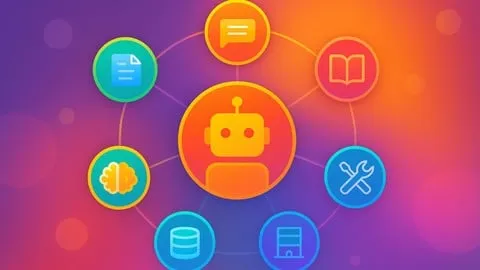
- Master the six core context types—Instructions, Examples, Knowledge, Memory, Tools, and Tool Results—to enable adaptive reasoning.
- Learn how to design role‑based prompt structures that guide agents toward specific objectives and behavioral constraints.
- Understand short‑term and long‑term memory architectures for multi‑turn conversations and token‑efficient workflows.
- Create tool‑driven integrations using function calling, API parameter design, and result chaining across LangChain, CrewAI, and LangGraph.
- Implement prompt compression, summarization, and token‑limit strategies to keep costs low while preserving performance.
- Apply self‑reflection and context refresh techniques to debug, improve, and scale autonomous agents.
- Analyze real‑world use cases and build a complete multi‑context AI agent from scratch in the capstone project.
Course Details
- Instructor: Vivian Aranha
- Rating: 4.3 stars (based on student reviews)
- Language: English (en‑US)
- Last updated: July 2026
- Certificate: Yes, upon completion
What This Course Covers
Foundations of Context Types
- Detailed exploration of the six context categories: Instructions, Examples, Knowledge, Memory, Tools, and Tool Results.
- How each context type influences LLM behavior and decision making.
- Practical examples of injecting structured domain knowledge into prompts.
- Real‑world scenarios where context selection determines agent success.
Prompt Engineering & Role Design
- Crafting role‑based prompts with clear objectives, constraints, and behavioral guidelines.
- Few‑shot and zero‑shot prompting techniques using positive and negative examples.
- Strategies for balancing instruction clarity with model creativity.
- Hands‑on exercises to refine prompt wording for specific agent tasks.
Memory Systems & Token Management
- Architecting short‑term memory for immediate context retention across turns.
- Building long‑term memory stores using vector databases and semantic search.
- Summarization and prompt compression methods to stay within token limits.
- Token‑efficient design patterns that reduce inference costs without sacrificing accuracy.
Tool Integration & Function Calling
- Defining tool descriptions, parameters, and return schemas for API integration.
- Implementing OpenAI function calling and custom tool wrappers.
- Chaining tool outputs across multiple agentic steps for complex workflows.
- Debugging tool result handling and ensuring reliable data flow.
Agent Orchestration Frameworks
- Overview of LangChain, CrewAI, and LangGraph architectures.
- Building modular, reusable pipelines that combine multiple context sources.
- Deploying orchestrated agents in cloud environments and local containers.
- Scaling agent workflows for production‑grade reliability.
Capstone Project & Real‑World Deployment
- Step‑by‑step guide to constructing a full multi‑context AI agent from scratch.
- Integration of memory, tool calls, and orchestration in a single end‑to‑end system.
- Testing, debugging, and performance profiling of the completed agent.
- Best practices for monitoring and iterating on deployed autonomous agents.
Who Should Take This Course
- Prompt engineers seeking to move beyond static templates into modular agent design.
- Software developers and AI engineers building multi‑step LLM‑based applications.
- Technical product managers responsible for designing AI‑powered features and assistants.
- Data scientists experimenting with autonomous decision‑making and workflow automation.
- AI enthusiasts and researchers who want a deeper understanding of context design principles for intelligent agents.
Prerequisites
- Basic familiarity with prompt engineering concepts and LLM terminology.
- Working knowledge of Python programming is recommended but not mandatory.
- No prior deep‑learning or neural‑network experience required.
Why Enroll in This Course
The course provides a comprehensive, production‑focused roadmap for building intelligent AI agents, a skill set in high demand across tech industries. A free coupon offers 100 % off for a limited time, making the training accessible while delivering real value without any cost barrier. Enrolling now ensures you benefit from the most up‑to‑date curriculum before the free offer expires later this month. Compared with generic LLM tutorials, this program emphasizes modular design, memory orchestration, and tool integration—key differentiators for real‑world deployments.
Course Highlights
- Lifetime access to all video lessons, exercises, and updates.
- Self‑paced learning allowing you to progress on your own schedule.
- Certificate of completion that validates your expertise in AI agent design.
- Hands‑on capstone project that demonstrates a fully functional multi‑context agent.
- Mobile‑friendly content so you can study on any device, anytime.
- Comprehensive resource library including downloadable code samples and reference guides.
Frequently Asked Questions
Q: Is this course really free?
A: Yes, the course can be accessed at no cost when
Affiliate link — we may earn a commission
Affiliate link — we may earn a commission. Learn more