
Embedded C Firmware Architecture - A Modular Approach
Affiliate link — we may earn a commission. Learn more
Embedded C Firmware Architecture – A Modular Approach by Mahmood Saadat is a comprehensive Udemy course that teaches you how to design portable, professional‑grade firmware. Updated July 2026, this free‑coupon‑eligible training covers modern firmware architecture, modular design patterns, and C best practices for any microcontroller. Whether you search for a free embedded C course, an embedded firmware Udemy course, or want to learn firmware architecture online, this program delivers practical, industry‑ready skills and a certificate of completion.
What You'll Learn
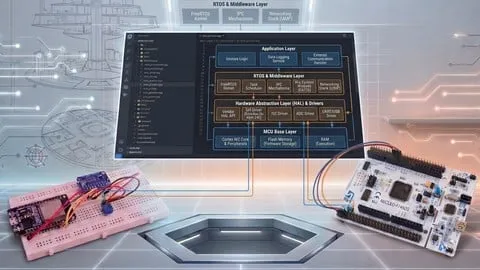
- Build a 4‑layer firmware stack that separates hardware, drivers, interfaces, and application logic.
- Master hardware‑abstraction techniques that make code portable across STM32, AVR, ESP32, and other MCUs.
- Learn the Embedded C Coding Standard, including Yoda conditions and strict naming conventions.
- Understand the Interface Pattern to decouple application code from low‑level drivers.
- Create reusable device drivers for sensors, displays, and communication peripherals.
- Implement defensive programming practices that eliminate magic numbers and assignment bugs.
- Apply GitHub Copilot to accelerate code generation while maintaining clean architecture.
- Analyze real‑world case studies that demonstrate migration from hobbyist to professional firmware projects.
Course Details
- Instructor: Mahmood Saadat
- Rating: 5.0 stars (792 reviews)
- Level: Intermediate / Advanced
- Language: English (en‑GB)
- Enrolled students: 792
- Last updated: Not specified
- Certificate: Yes, upon completion
- Includes: Lifetime access, mobile‑friendly videos, downloadable resources
What This Course Covers
Firmware Architecture Fundamentals
- Overview of why modular firmware matters for portability and maintainability.
- Comparison of bare‑metal coding versus architected solutions.
- Key principles of layered software design in embedded systems.
- Real‑world examples of architecture failures and how to avoid them.
The 4‑Layer Framework
- HAL (Hardware Abstraction Layer): Hiding silicon specifics behind clean APIs.
- Device Layer: Building reusable drivers for sensors, LCDs, and communication modules.
- Interface Layer: Defining contracts between hardware and business logic.
- Application Layer: Writing pure, hardware‑agnostic code that scales across projects.
Embedded C Coding Standards
- Detailed walkthrough of the Embedded C Coding Standard used in the course.
- Enforcing “Yoda conditions” and naming conventions for readability.
- Techniques for eliminating magic numbers and improving code safety.
- Automated linting and static analysis tools integration.
Interface Pattern & Modular Design
- Implementing the Interface Pattern to achieve loose coupling.
- Designing modular APIs that simplify testing and future extensions.
- Strategies for versioning and maintaining backward compatibility.
- Hands‑on exercises refactoring legacy code into modular components.
Professional Starter Kit & Tools
- Building a “Professional Starter Kit” template for rapid project kickoff.
- Setting up project structure with Init, Callback, and Global modules.
- Using GitHub Copilot to generate boilerplate while adhering to standards.
- Exporting the template to GitHub for collaborative development.
Who Should Take This Course
- Intermediate Embedded C developers seeking to adopt professional architecture practices.
- Senior firmware engineers who need a standardized, portable codebase for multiple MCUs.
- Electronic engineers transitioning from hardware design to embedded software.
- Students and career changers aiming to break into the embedded systems industry.
- Firmware managers looking for a repeatable framework to guide their teams.
Prerequisites
- Understanding of C fundamentals such as loops, pointers, and structs.
- Familiarity with at least one microcontroller and basic electronic concepts.
- A desire to move from hobbyist‑style coding to professional firmware habits.
Why Enroll in This Course
This course delivers a rare architectural focus that goes beyond syntax, teaching you how to build scalable firmware for any MCU. A free coupon provides 100 % off for a limited time, making it an ideal way to start mastering embedded C without financial risk. The hands‑on projects, coding standards, and starter‑kit template give you immediate, job‑ready results that many generic tutorials lack. Enroll now while the free coupon remains active and accelerate your path to professional firmware development.
Course Highlights
- Lifetime access to all video lessons, source code, and updates.
- Self‑paced learning allows you to progress at your own speed.
- Certificate of completion to showcase your new expertise on LinkedIn.
- Mobile‑friendly design lets you study on tablets or smartphones.
- Downloadable resources include project templates, coding standards, and cheat sheets.
- Practical, real‑world examples illustrate how to migrate existing codebases to a modular architecture.
Frequently Asked Questions
Q: Is this course really free?
A: Yes, the course can be accessed for free using the available Udemy coupon, which provides a 100 % discount for a limited period. No payment information is required to enroll while the coupon remains valid.
Q: What will I learn in this Embedded C firmware course?
Affiliate link — we may earn a commission
Affiliate link — we may earn a commission. Learn more