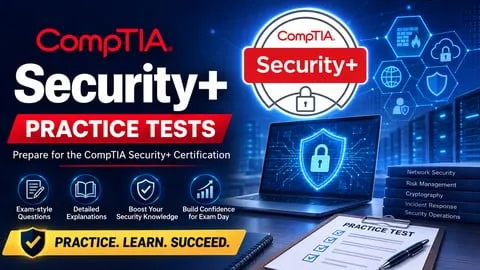
CompTIA Security+ Certification Practice Test 500+ Questions
Affiliate link — we may earn a commission. Learn more
CompTIA Security+ Certification Practice Test 500+ Questions Review
Looking for a free CompTIA Security+ course to validate your cybersecurity skills? The CompTIA Security+ Certification Practice Test 500+ Questions led by instructor Duc Duy Bui is a comprehensive Udemy course designed to prepare candidates for one of the most respected certifications in the IT industry. Updated July 2024, this training focuses on bridging the gap between theoretical knowledge and exam-day performance by providing extensive, realistic simulation questions. Whether you want to learn cybersecurity online or are specifically seeking a CompTIA Security+ Udemy course, this practice-centric approach ensures you are fully prepared to earn your certification and advance your career in information security.
What You'll Learn
- Assess your overall readiness for the CompTIA Security+ certification exam through a massive bank of 500+ realistic questions.
- Master core security concepts and principles to ensure a deep understanding of the theoretical foundations of cybersecurity.
- Identify diverse threats, vulnerabilities, and common attack vectors while implementing appropriate mitigation strategies.
- Analyze security architecture, cloud security models, and secure infrastructure designs to protect organizational assets.
- Implement security operations, including continuous monitoring, vulnerability management, and endpoint security protocols.
- Apply identity and access management (IAM) principles, focusing on authentication, authorization, and privileged access.
- Review complex cryptography concepts, including PKI, certificates, encryption standards, and secure hashing algorithms.
- Evaluate risk management frameworks, business continuity plans, and disaster recovery strategies to ensure organizational resilience.
Course Details
- Instructor: Duc Duy Bui
- Rating: 4.7 stars
- Level: Intermediate
- Language: English
- Certificate: Yes, upon completion
- Includes: Lifetime access, mobile-friendly content, and detailed answer explanations
What This Course Covers
General Security Concepts and Governance
- Comprehensive review of the CIA triad (Confidentiality, Integrity, and Availability) and its application in real-world scenarios
- Detailed analysis of authentication, authorization, and accounting (AAA) frameworks
- Implementation of security controls and the various types of governance frameworks used in the industry
- Understanding change management processes to maintain security stability during system updates
- Mastery of basic cybersecurity terminology essential for professional communication and the certification exam
Threats, Vulnerabilities, and Mitigations
- Identification of various malware types and common attack vectors used by threat actors
- Analysis of social engineering tactics, including sophisticated phishing and credential harvesting attacks
- Evaluation of different vulnerability types and how to prioritize them using risk scores
- Study of network-based attacks and application-layer vulnerabilities, including web-based threats
- Recognition of indicators of compromise (IoC) to detect active security breaches within a network
- Practical application of security mitigation techniques to neutralize identified threats
Security Architecture and Cloud Infrastructure
- Design and implementation of secure network architectures to minimize the attack surface
- Exploration of enterprise security concepts and the integration of security into business workflows
- Deep dive into cloud and virtualization security, covering shared responsibility models
- Implementation of Zero Trust architecture to ensure "never trust, always verify" security postures
- Strategic use of network segmentation to isolate critical assets and prevent lateral movement
- Design of resilient and redundant infrastructures to ensure high availability and data protection
Security Operations and Endpoint Management
- Mastery of security monitoring and the use of logging concepts to track system events
- Deployment of endpoint security solutions to protect devices from advanced persistent threats
- Application of network security technologies, including firewalls, IDS, and IPS
- Systematic approach to vulnerability management and configuration management practices
- Implementation of secure deployment practices to ensure software is hardened before production
- Utilization of modern security tools and technologies for real-time threat hunting
Identity and Access Management (IAM)
- Understanding identity concepts and the lifecycle of user accounts within an organization
- Comparison of various authentication methods and the critical role of Multi-factor Authentication (MFA)
- Application of access control models, such as Role-Based Access Control (RBAC) and Attribute-Based Access Control (ABAC)
- Management of privileged access (PAM) to prevent the misuse of administrative credentials
- Implementation of federation and single sign-on (SSO) to improve user experience and security
- Process of access provisioning and deprovisioning to maintain the principle of least privilege
Cryptography and Data Security
- Fundamental cryptographic concepts, including the differences between symmetric and asymmetric encryption
- Application of hashing algorithms to ensure data integrity and prevent unauthorized modifications
- Use of digital signatures and certificates to verify identity and ensure non-repudiation
- Detailed study of Public Key Infrastructure (PKI) and the role of Certificate Authorities (CAs)
- Implementation of key management strategies to secure cryptographic keys throughout their lifecycle
- Application of data protection techniques for data at rest, in transit, and in use
Incident Response and Digital Forensics
- Implementation of the full incident response lifecycle, from preparation to post-incident activity
- Techniques for detection and analysis to accurately identify the scope of a security breach
- Strategies for containment, eradication, and recovery to restore services while preserving evidence
- Proper incident documentation and reporting for legal and regulatory compliance
- Application of digital forensics concepts to collect and analyze electronic evidence
- Conducting security incident investigations to determine the root cause of a failure
Risk Management and Governance
- Systematic risk identification and assessment to determine the organization's risk appetite
- Quantitative and qualitative risk analysis to prioritize security investments
- Implementation of risk treatment options, including avoidance, transference, mitigation, and acceptance
- Conducting Business Impact Analysis (BIA) to identify critical business functions
- Development of business continuity and disaster recovery plans to maintain operations during a crisis
- Management of third-party and supply-chain risks to ensure vendor security compliance
Who Should Take This Course
- Certification Candidates: Individuals specifically preparing for the CompTIA Security+ exam who need realistic practice.
- IT Professionals: System administrators and network engineers looking to validate and strengthen their cybersecurity knowledge.
- Career Switchers: IT support professionals transitioning into dedicated cybersecurity roles or SOC analyst positions.
- Academic Students: Students studying information technology, computer science, or cybersecurity who want a practical test of their knowledge.
- Security Analysts: Aspiring cybersecurity analysts who want to identify their knowledge gaps before attempting the professional certification.
Prerequisites
- Basic IT Knowledge: A fundamental understanding of how computers and operating systems function.
- Networking Basics: Familiarity with TCP/IP, DNS, and basic network routing/switching.
- Introductory Security Concepts: This is a practice test course, so learners should have already completed a study guide or training course.
- No advanced experience required: While basic knowledge is needed, no prior professional security experience is mandatory to take the tests.
Why Enroll in This Course
Preparing for the CompTIA Security+ exam requires more than just reading a textbook; it requires the ability to apply knowledge to complex, scenario-based questions. This course provides a high-volume question bank that simulates the actual exam environment, helping you build the speed and accuracy necessary for success. For a limited time, you can access this resource via a free coupon, offering the training 100% off. Given the time-sensitive nature of these offers, enrolling now allows you to secure a professional-grade test bank without financial investment, making it the most efficient way to prepare for your certification.
Course Highlights
- Extensive Question Bank: Over 500 questions covering every major domain of the Security+ exam.
- Detailed Explanations: Every answer comes with a thorough explanation, transforming a test into a learning tool.
- Scenario-Based Learning: Questions are designed as real-world scenarios, mirroring the actual CompTIA exam style.
- Self-Paced Flexibility: Learn and test your knowledge on your own schedule with lifetime access to materials.
- Comprehensive Domain Coverage: Ensures no topic is left untouched, from cryptography to risk management.
- Confidence Building: Repeated exposure to exam-style questions reduces test anxiety and improves performance.
Frequently Asked Questions
Q: Is this course really free? A: Yes, this course is available for free when you use a valid limited-time coupon. Once you enroll using the coupon, you gain full access to all 500+ practice questions and the certificate of completion at no cost.
Q: What will I learn in this CompTIA Security+ course? A: While this is not a lecture-based course, you will learn how to apply cybersecurity concepts to solve practical problems. By reviewing the detailed explanations for each question, you will master topics like threat mitigation, IAM, cryptography, and risk management.
Q: Do I get a certificate after completing this course? A: Yes, upon completing the practice tests and the course requirements, you will receive a certificate of completion from Udemy. This serves as a record of your preparation and dedication to mastering the Security+ domains.
Q: Is this course suitable for absolute beginners? A: This course is designed as a practice tool rather than an introductory tutorial. It is best suited for those who have already studied the Security+ material and want to test their knowledge before taking the official exam.
Q: How long do I have to enroll for free? A: Free coupons are typically available for a very limited time or for a specific number of redemptions. It is recommended to enroll as soon as possible to ensure you secure your free lifetime access.
Final Thoughts
The CompTIA Security+ Certification Practice Test 500+ Questions is an essential resource for anyone serious about passing their certification on the first attempt. By combining the expertise of Duc Duy Bui with a rigorous set of practice exams, learners can pinpoint their weaknesses and master the CompTIA Security+ topic with confidence. Start your journey toward becoming a certified cybersecurity professional today and secure your future in the IT industry.
Affiliate link — we may earn a commission
Affiliate link — we may earn a commission. Learn more