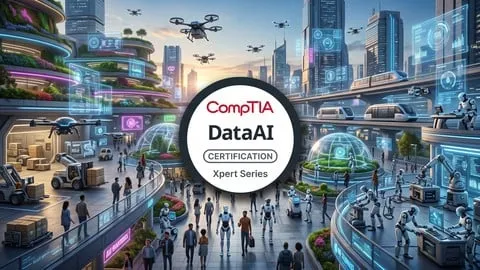
CompTIA DataAI DY0-001 V1: Practice Tests
Affiliate link — we may earn a commission. Learn more
CompTIA DataAI DY0-001 V1: Practice Tests by Robert Karamagi helps you master the CompTIA DataAI certification exam. This free Udemy course targets candidates who want to learn data‑science fundamentals, machine‑learning concepts, and AI operations online. Updated July 2026, the curriculum delivers domain‑by‑domain practice tests that mirror the official exam structure. By completing the course, you gain the skills needed to pass the DY0‑001 exam and earn a vendor‑neutral certification.
What You'll Learn
- Build domain‑specific test strategies for Mathematics and Statistics, covering probability, linear algebra, and calculus fundamentals.
- Master modeling and analysis techniques, including hypothesis testing, regression, and outcome evaluation across real‑world data sets.
- Learn core machine‑learning algorithms, such as supervised, unsupervised, and reinforcement learning, with practical implementation guidance.
- Understand data‑science operations and processes, focusing on data cleaning, pipeline orchestration, and governance best practices.
- Create specialized AI applications, exploring natural‑language processing, computer‑vision, and edge‑AI use cases.
- Implement performance‑based decision‑making, selecting appropriate models based on business requirements and statistical validity.
- Apply exam‑style questions to identify knowledge gaps and reinforce retention through timed practice.
- Analyze industry trends and emerging technologies, ensuring readiness for future data‑science challenges.
These outcomes equip you with concrete, job‑ready capabilities that align directly with CompTIA’s certification objectives.
Course Details
- Instructor: Robert Karamagi
- Language: English (en‑US)
- Certificate: Yes, upon completion
- Includes: Lifetime access to all practice tests, mobile‑friendly learning platform, downloadable answer explanations
The course focuses exclusively on practice examinations, allowing you to assess readiness for each certification domain. No video lectures are required; instead, you engage with authentic multiple‑choice and performance‑based items that replicate the real exam environment.
What This Course Covers
Domain 1.0 – Mathematics and Statistics
- Probability theory, random variables, and distributions relevant to data‑science tasks
- Linear algebra concepts, including vectors, matrices, and transformations
- Calculus fundamentals such as differentiation and integration for model optimization
- Statistical inference techniques, covering confidence intervals and hypothesis testing
Domain 2.0 – Modeling, Analysis, and Outcomes
- Selection of appropriate statistical models for diverse business problems
- Regression analysis, classification, and clustering methods with real‑world examples
- Model evaluation metrics, including accuracy, precision, recall, and ROC curves
- Decision‑making frameworks that translate analytical results into actionable outcomes
Domain 3.0 – Machine Learning
- Supervised learning algorithms: decision trees, support vector machines, and neural networks
- Unsupervised learning techniques: k‑means clustering, principal component analysis, and dimensionality reduction
- Reinforcement learning basics, policy evaluation, and reward‑based optimization
- Model deployment considerations, monitoring, and continuous improvement cycles
Domain 4.0 – Operations and Processes
- Data acquisition, cleaning, and preprocessing pipelines for large‑scale datasets
- Workflow automation using scripting, orchestration tools, and containerization
- Governance, security, and compliance practices for AI projects
- Performance monitoring, logging, and error handling in production environments
Domain 5.0 – Specialized Applications of Data Science
- Natural‑language processing pipelines, tokenization, and sentiment analysis techniques
- Computer‑vision fundamentals, image preprocessing, and convolutional neural networks
- Edge‑AI deployment strategies for low‑latency inference on embedded devices
- Emerging AI trends such as explainable AI, federated learning, and responsible AI practices
Together, these modules replicate the official exam weighting, ensuring balanced preparation across all required competencies.
Who Should Take This Course
- Experienced data scientists seeking a vendor‑neutral certification to validate expertise.
- Machine‑learning engineers preparing for the CompTIA DataAI exam to demonstrate professional credibility.
- Quantitative analysts who need structured practice tests to assess statistical modeling skills.
- Senior data professionals aiming to showcase mastery of AI operations, governance, and specialized applications.
- IT managers responsible for evaluating team readiness for enterprise‑level data‑science initiatives.
The curriculum assumes a solid foundation in data‑science concepts, making it ideal for professionals with at least five years of hands
Affiliate link — we may earn a commission
Affiliate link — we may earn a commission. Learn more