
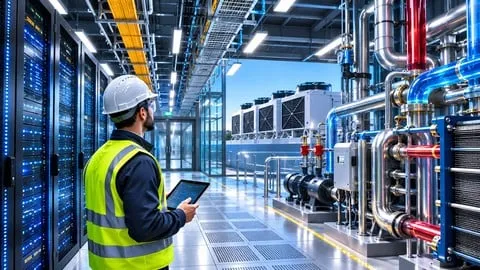
AI Data Center Cooling: Liquid Cooling & HVAC System Design
Affiliate link — we may earn a commission. Learn more
AI Data Center Cooling: Liquid Cooling & HVAC System Design – taught by Chartered Engineers
If you’re searching for a free AI data center cooling course or the best AI data center cooling Udemy course to learn AI cooling online, this masterclass fits the bill. Updated July 2026, the program delivers hands‑on engineering calculations, real‑world case studies, and a downloadable toolbox that prepares you to design liquid‑cooling and HVAC solutions for high‑density AI facilities. The Udemy format lets you study at your own pace while earning a certificate that validates your new skills.
What You'll Learn
- Build detailed thermal load models for AI rack configurations using industry‑standard formulas.
- Master airflow sizing and distribution for CRAH units, fan walls, and containment strategies.
- Learn to size direct‑to‑chip liquid‑cooling loops, cold plates, and coolant distribution units (CDUs).
- Understand hydraulic calculations for pipe networks, pump selection, and pressure‑loss analysis.
- Create HVAC, chilled‑water, dry‑cooling, adiabatic, and free‑cooling system designs tailored to AI facilities.
- Implement immersion‑cooling assessments, technology comparisons, and retrofit planning.
- Apply redundancy planning, leak‑detection schemes, FMEA, and thermal ride‑through solutions.
- Analyze energy‑efficiency metrics such as PUE, WUE, annual cooling energy, and heat‑reuse potential.
Course Details
- Instructor: Chartered Engineers
- Rating: 4.6 stars (based on student reviews)
- Language: English (en‑US)
- Enrolled students: 45,644
- Last updated: July 2026
- Certificate: Yes, upon completion
- Includes: Lifetime access, mobile‑friendly videos, downloadable PDFs and Excel calculation tools
What This Course Covers
Thermal Load & Rack Design
- Compute AI rack thermal loads, density metrics, and heat‑transfer envelopes.
- Evaluate server‑level power consumption and translate it into cooling requirements.
- Perform case‑study calculations for a fictional AI data center project.
- Generate design documentation for mechanical deliverables.
HVAC & Airflow Strategies
- Design airflow pathways using CRAH units, fan walls, and containment systems.
- Size in‑row cooling, rear‑door heat exchangers, and ductwork for optimal distribution.
- Analyze pressure differentials and fan performance curves.
- Integrate HVAC controls with building management systems.
Liquid Cooling & CDUs
- Select cold‑plate materials, coolant types, and flow configurations for direct‑to‑chip cooling.
- Size coolant distribution units (CDUs) and calculate flow rates and temperature drops.
- Model rack manifolds and loop hydraulics for uniform cooling.
- Compare single‑phase and two‑phase liquid‑cooling technologies.
Hydraulic & Piping Engineering
- Perform pipe‑sizing calculations based on pressure loss and flow velocity criteria.
- Determine pump head requirements, power consumption, and efficiency curves.
- Design hydraulic loops with redundancy and surge protection.
- Use Excel‑based tools to automate hydraulic analysis.
Heat Rejection & Sustainability
- Size chillers, dry coolers, adiabatic coolers, and free‑cooling loops for AI facilities.
- Calculate PUE, WUE, and annual energy consumption for the cooling plant.
- Explore heat‑reuse opportunities such as district heating or absorption cooling.
- Conduct life‑cycle cost analysis for sustainable design decisions.
Reliability & Control Systems
- Develop redundancy architectures, N+1 and 2N+1 configurations for critical cooling paths.
- Implement leak‑detection sensors, alarm logic, and automated shutdown procedures.
- Conduct Failure Mode and Effects Analysis (FMEA) for thermal ride‑through scenarios.
- Program basic control strategies using PLC logic and building automation protocols.
Who Should Take This Course
- Mechanical and HVAC engineers designing data‑center cooling infrastructure.
- Facilities or process engineers transitioning into high‑density AI computing environments.
- Design managers and owner’s engineers responsible for reviewing technical cooling designs.
- Professionals seeking to specialize in liquid‑cooling, immersion‑cooling, or advanced HVAC solutions.
- Engineers aiming to improve energy‑efficiency metrics (PUE, WUE) for AI data centers.
Prerequisites
- Basic understanding of thermodynamics and fluid mechanics.
- Familiarity with HVAC terminology and equipment is helpful but not mandatory.
- No prior experience with AI hardware is required; the course starts from fundamental concepts.
Why Enroll in This Course
This masterclass delivers a complete engineering workflow—from thermal load calculation to system integration—without the fluff found in generic tutorials. A free coupon provides 100 % off for a limited time, making the high‑value content accessible while the offer lasts. Compared with other Udemy titles, this course stands out for its depth of calculations, extensive downloadable resources, and real‑world case study that mirrors industry practice.
Course Highlights
- Lifetime access to 45 video lessons and all supplemental materials.
- Self‑paced learning with downloadable PDFs, 267 Excel tools, and practice questions.
- Certificate of completion that showcases expertise in AI data‑center cooling design.
- Mobile‑friendly platform lets you study on tablets or smartphones.
- Energy‑efficiency focus with PUE/WUE calculations and heat‑reuse strategies.
- Comprehensive coverage of liquid, immersion, and traditional HVAC cooling technologies.
Frequently Asked Questions
Q: Is this course really free?
A: Yes. By applying the free Udemy coupon, you can enroll at no cost for the duration of the promotion. The coupon provides 100 % off the listed price, granting full access to all course materials.
Q: What will I learn in this AI data center cooling course?
A: You will master thermal load calculations, airflow and liquid‑cooling design, hydraulic engineering, heat‑rejection systems, reliability planning, and energy‑efficiency metrics. Each topic includes practical examples, Excel tools, and a complete case study.
Q: Do I get a certificate after completing this course?
A: A Udemy certificate of completion is awarded once you finish all lessons and pass the optional assessments. This certificate can be added to your résumé or LinkedIn profile to demonstrate your new skill set.
Q: Is this course suitable for beginners?
A: The material assumes basic thermodynamics and HVAC knowledge, but it is structured to guide newcomers through each concept step‑by‑step. Beginners in data‑center cooling will find the foundational sections especially helpful.
Q: How long do I have to enroll for free?
A: The free coupon is available for a limited time; the exact expiration is displayed on the Udemy enrollment page. Enroll before the coupon expires to secure 100 % off and retain lifetime access.
Final Thoughts
AI Data Center Cooling: Liquid Cooling & HVAC System Design equips mechanical, HVAC, and facilities engineers with the practical expertise needed to tackle the thermal challenges of modern AI workloads. Enroll now, claim the free coupon, and start designing the next generation of high‑performance, energy‑efficient data centers. Your journey toward mastering AI data‑center cooling begins today.
Affiliate link — we may earn a commission
Affiliate link — we may earn a commission. Learn more