
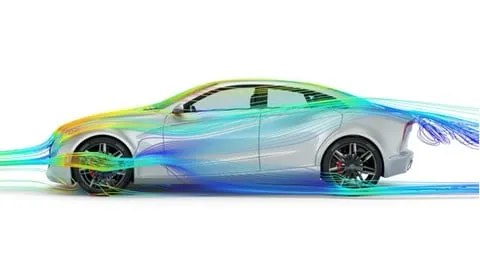
Advanced Fluid Mechanics & Computational Fluid Dynamics
Affiliate link — we may earn a commission. Learn more
Master Fluid Dynamics: Advanced Fluid Mechanics & Computational Fluid Dynamics Course Review
Looking to master the complexities of fluid behavior? The Advanced Fluid Mechanics & Computational Fluid Dynamics course provided by OZIS Academy on Udemy is a comprehensive educational resource designed for those who want to learn fluid mechanics online. Updated for 2024, this professional training bridges the gap between theoretical physics and real-world engineering applications, making it a top choice for anyone searching for a high-quality CFD Udemy course. Whether you are looking for a free fluid mechanics course via a limited-time offer or a deep dive into numerical simulations, this curriculum provides the necessary tools to achieve professional certification and technical mastery.
What You'll Learn
- Master the Navier-Stokes Equation and comprehend its wide-ranging applications in modern fluid dynamics.
- Build a comprehensive understanding of the Reynolds Transport Theorem (RTT) through detailed mathematical derivation and practical implication.
- Analyze the performance of Turbo Machines using Euler's Equation, velocity triangles, and blade angle analysis.
- Implement boundary layer concepts, including the Blasius solution and the analysis of turbulent flow over flat plates.
- Calculate drag and lift coefficients to optimize vehicle aerodynamics and enhance the performance of airfoils.
- Create numerical simulations using Computational Fluid Dynamics (CFD) techniques and the Finite Difference Method.
- Apply linear and angular momentum equations to solve complex engineering problems in various industrial contexts.
- Evaluate the kinematics of different flow types, including the visualization of streamlines, path-lines, and streak-lines.
Course Details
- Instructor: OZIS Academy
- Rating: 4.2 stars (74,524 reviews)
- Level: Beginner to Advanced
- Language: English
- Enrolled students: 74,524
- Certificate: Yes, upon completion
- Includes: Lifetime access, mobile-friendly content, and on-demand video lectures
What This Course Covers
Fundamental Fluid Equations
- Detailed exploration of the Principle of Conservation of Mass
- Differential and Integral approaches to the Continuity Equation
- Comprehensive study of the Momentum Equation in both general and differential forms
- Application of the Navier-Stokes Equation for steady and laminar fluid flow between fixed plates
- Calculation of velocity profiles, volume flow rates, and Reynolds Numbers
Reynolds Transport Theorem (RTT)
- Transitioning from Control Mass (System) to Control Volume (CV)
- Step-by-step derivation of the Reynolds Transport Theorem
- Deriving the Continuity Equation using RTT for mass flow analysis
- Application of RTT to linear and angular momentum equations
- Solving complex numerical problems using integral forms of the continuity equation
Flow Kinematics and Potential Flow
- Visualization of fluid flow using streamlines, path-lines, streak-lines, and timelines
- Analysis of irrotational flow fields and the role of the Vorticity Vector
- Utilization of stream functions and velocity potential functions in cylindrical coordinates
- Superposition of basic potential flows to analyze flow around cylinders and Rankine bodies
- Study of the Magnus Effect and its relationship with circulation and vorticity
Turbo-machinery and Hydraulic Turbines
- Classification of fluid machines, including positive displacement and roto-dynamic pumps
- Application of Euler’s Equation to one-dimensional flow through an impeller
- Analysis of blade angles and their effect on the head and characteristic curves
- Evaluation of pump efficiency, losses, and specific speed
- Detailed study of Impulse and Reaction turbines, including degree of reaction and energy equations
Boundary Layer and External Flow
- In-depth analysis of the Prandtl-Boundary layer concept and flow separation
- Order of magnitude and scale analysis over flat plates
- Application of the Blasius solution for laminar boundary layer friction coefficients
- Study of displacement and momentum thickness using Von Karman Integral equations
- Analysis of drag and lift forces, drag coefficients for common geometries, and vehicle aerodynamics
- Performance characteristics of airfoils, including the effect of the angle of attack and Mach number
Computational Fluid Dynamics (CFD)
- Introduction to the scope and role of CFD in modern engineering
- Step-by-step practical process for solving fluid problems numerically
- Implementation of the Finite Difference Method using forward, backward, and central differences
- Practical application of CFD solving using industry-standard software like ANSYS-CFX
- Technical workflows for geometry creation, meshing, and post-processing results
Who Should Take This Course
- Mechanical, Civil, Chemical, and Aerospace Engineers: Professionals who require a rigorous understanding of fluid behavior to design systems, pipelines, or aircraft.
- Undergraduate and Graduate Students: Engineering students seeking a solid academic foundation to supplement their university curriculum in fluid mechanics.
- Industry Professionals: Those working in the automotive, energy, and manufacturing sectors who need to enhance their practical skills in fluid system design.
- Researchers and Academics: Professors and postgraduate students who wish to delve deeper into advanced topics like CFD and Potential Flow for research purposes.
- Aspiring CFD Specialists: Individuals looking to transition into roles involving numerical simulation, hydraulic engineering, or aerostructure design.
Prerequisites
- Basic Mathematics: A fundamental understanding of calculus and differential equations is recommended for following the derivations.
- Basic Physics: Familiarity with Newton's laws of motion is helpful.
- Beginner Friendly: No prior advanced fluid mechanics experience is required, as the course begins with an introductory overview of the subject.
Why Enroll in This Course
This course is an exceptional value proposition because it transforms abstract mathematical theories into practical engineering tools. While many courses focus solely on the math, this program bridges the gap between the textbook and real-world application, utilizing references like Cengel and Munson. For a limited time, students may be able to access this training via a free coupon, offering 100% off the standard enrollment fee. Given the high enrollment numbers and professional depth of the content, this is a rare opportunity to gain expert-level knowledge in CFD and Fluid Mechanics without a significant financial investment.
Course Highlights
- Comprehensive Curriculum: The course moves logically from basic viscosity to highly advanced CFD simulations.
- Practical Software Integration: Includes exposure to tools like ANSYS-CFX and flow visualization software.
- Academic Rigor: Uses established engineering reference books to ensure the material is accurate and industry-standard.
- Self-Paced Learning: With lifetime access, learners can revisit complex derivations and numerical problems at their own speed.
- Career-Ready Certification: The certificate of completion serves as a testament to your proficiency in advanced fluid dynamics.
- Broad Application: The content is applicable across multiple industries, from automotive drag reduction to turbine efficiency.
Frequently Asked Questions
Q: Is this course really free? A: Yes, this course is often available for free through limited-time promotional coupons. When a 100% off coupon is active, you can enroll in the course without paying the standard Udemy fee and still receive full access to all materials.
Q: What will I learn in this Advanced Fluid Mechanics and CFD course? A: You will cover a vast range of topics starting from the basics of Newtonian fluids and the Navier-Stokes equations to complex areas like the Reynolds Transport Theorem and Potential Flow. Additionally, you will learn about turbo-machinery, boundary layer theory, external aerodynamics (lift and drag), and the fundamentals of Computational Fluid Dynamics (CFD).
Q: Do I get a certificate after completing this course? A: Yes, upon successfully completing all the video lectures and requirements, Udemy provides a certificate of completion. This certificate can be added to your LinkedIn profile or resume to demonstrate your expertise in fluid mechanics and CFD to potential employers.
Q: Is this course suitable for absolute beginners? A: Yes, the course is designed to be accessible. It begins with an introductory overview of fluid mechanics tailored for beginners, covering fundamental principles before moving into the more advanced mathematical derivations and computational methods.
Q: How long do I have to enroll for free? A: Free coupons on Udemy are typically available for a very limited time or for a specific number of redemptions. It is highly recommended to enroll as soon as you find an active coupon to ensure you secure lifetime access to the course materials.
Final Thoughts
The Advanced Fluid Mechanics & Computational Fluid Dynamics course is an essential resource for any engineer or student looking to master the laws governing fluid motion. By combining theoretical rigor with practical CFD applications, OZIS Academy provides a clear pathway to expertise in aerospace, automotive, and mechanical engineering. Whether you are pursuing academic excellence or professional career advancement, this course is the perfect starting point for your learning journey.
Affiliate link — we may earn a commission
Affiliate link — we may earn a commission. Learn more